
🌍 Study Abroad, 🧑🎓 Study Abroad Interviews
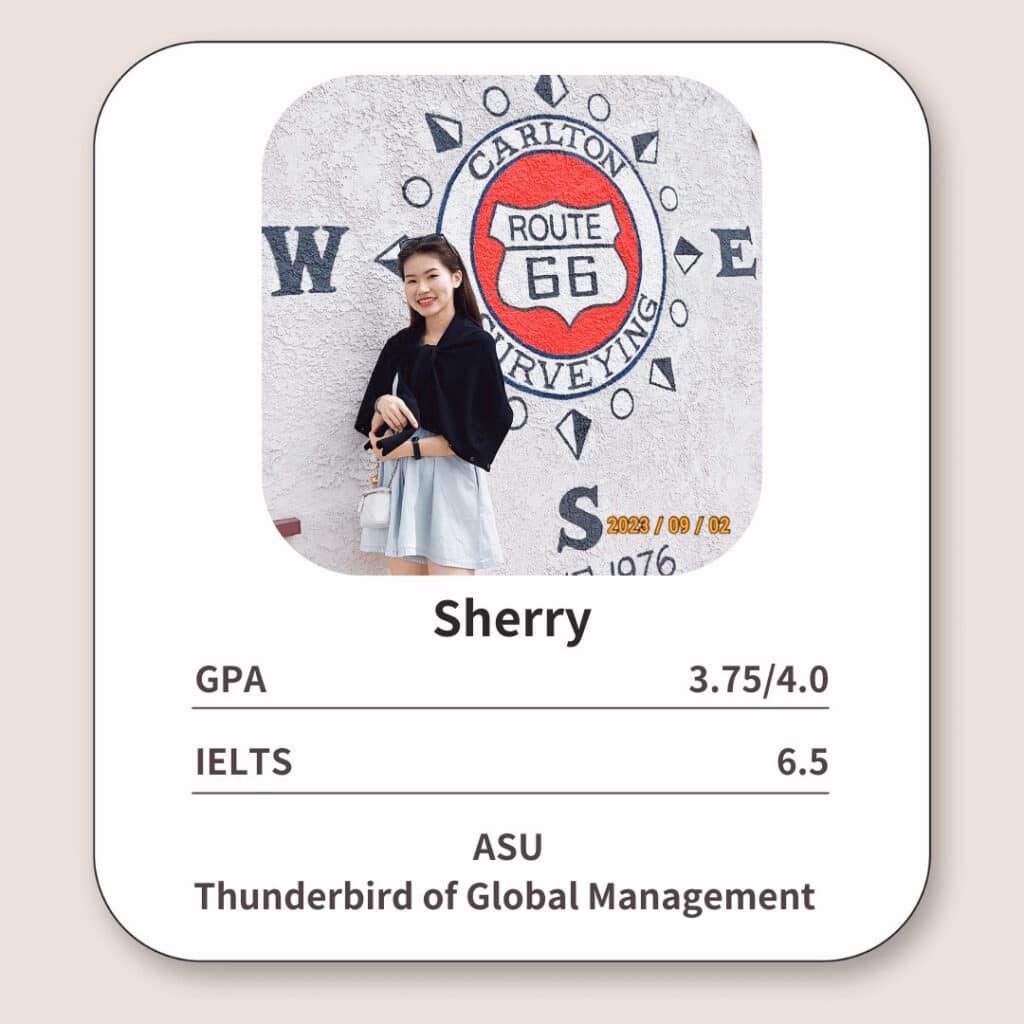
ASU Thunderbird Master of Global Management: Sherry’s Story
Updated 2026/10/16
Jason’s Memo
After building up work experience in Taiwan, Sherry went to ASU Thunderbird for a Master of Global Management, and the school’s career resources helped her a lot.
- GCL Program: Before graduating, every student does a three-week short internship at a company, with the school paying for flights and lodging. That’s where the 96% internship rate comes from.
- Career coach: Every student gets a career coach and can book sessions for resume editing, interview coaching and job-search planning.
- On-campus job: She got an on-campus part-time job through an opening an older schoolmate recommended, and having an on-campus job lets you apply for an SSN.
Today Sherry shares why, after building up some work experience in Taiwan, she stepped out of her comfort zone to do a master’s in the US. Along with a detailed look at the school and program, she talks about her experience studying abroad, what she learned, the challenges and the things she didn’t expect. I hope it gives you some new ideas. Let’s find the oasis in the desert together!
About ASU’s Master of Global Management
The Master of Global Management at the Thunderbird School of Global Management ranks first in the world in the QS International Trade Rankings 2024. This full-time master’s gives graduates the skills to lead diverse cross-cultural teams, whether in private companies, the public sector, nonprofits, startups or social enterprises.
The program builds on a traditional business administration curriculum and adds Industry 4.0 skills such as digital transformation, Sustainability/ESG, diversity and inclusion, entrepreneurship and innovation. It also offers more than 16 Transdisciplinary Concentrations, ranging from global affairs and public administration to data science and healthcare delivery.
What does the program focus on, what’s distinctive about it, and what are classes like?
The program is STEM designated, and classes are seated in small groups or teams. You won’t find lectures with 200 to 300 people in one big hall.
Why did you choose to apply to this program?
My undergraduate degree was in international business. I also applied to some BA (business analytics) programs at the time, but after weighing it up I felt business analytics wasn’t really for me, and Management would be easier for me to get into.
You already had full-time work experience in Taiwan. What made you decide to study abroad?
At the company and in the industry I was in, I could feel what people call a “career ceiling,” and that scared me, since I’d only just started working. When you can see the end of the road in a job or a company, I think it’s time to start thinking about your next move. Changing jobs was an option too, but I’d always dreamed of studying abroad. Something in me said your twenties are when you have the fewest obligations and worries holding you back from chasing a dream. It was time to act instead of keeping the dream buried and regretting it at 30. I also want to be able to get work experience at an American or foreign company in the future. For me, going after the next, better goal is more rewarding than staying in my comfort zone.
Here’s a little story. There was a senior manager at my company who had been there 18 years, probably 45 to 50 years old. Around the same time I was applying to schools, she suddenly dropped the bombshell that she was quitting. She chose to go to Canada on a working holiday with study (she picked Canada because its age limit is looser). I was surprised and really admired her. I think going abroad at an older age takes even more courage and effort, and her decision made me want even more to get into a school abroad.
Life is too short. If not now, when?
Career resources at Arizona State University (ASU)
The program reports a 96% internship rate and 85% employment within four months of graduation. Does the curriculum put special emphasis on careers?
ASU is the largest state university in Arizona. When you network with alumni, if they’re also from ASU they’re friendly even if you’re complete strangers, and they’re happy to give younger students advice and direction. If you have questions, I’d say alumni reply to messages at a very high rate. Back to Thunderbird, where I study: Thunderbird is a business school under ASU, best described as a college within the university. The 96% internship rate comes from a part of our curriculum called the GCL Program. Before graduating, everyone has to do a three-week short internship at a company (in the US, domestic, or outside the US, international). It takes half a semester to complete, and the school covers flights and lodging. GCL is one of the best parts of the Thunderbird curriculum.
From your own experience, did the school’s career resources help you? For example, the Career Center or the alumni network?
ASU is huge (laughs), with 4 campuses in total, and at the main campus in Tempe there are more career talks and job fairs than you could ever attend. Thunderbird is focused on master’s degrees, and the professors and the school basically assume this will be the highest degree most students ever earn. The school also knows most people need to find a job as soon as they graduate. From the moment we enrolled, the career center gave us a series of tasks, like learning how to write a resume & cover letter for jobs abroad, and there are job-search workshops you can attend.
Everyone is assigned a career coach. I kept in very close touch with my career coach. Whenever I needed resume editing, interview coaching, job-search planning and so on, I could book time with them. After every session I felt recharged and ready to push forward even harder.
As for the alumni network, Thunderbird is, as I said, a school of its own, so alumni connections are even stronger. At Thunderbird I got a lot of help with coursework from older students, plus advice from people who’d been through it. Even after they graduated, our shared Thunderbird background kept our networks closely overlapping and our relationships strong. I really love how this network gets passed down from one class to the next. I’ve recently become one of the older students myself, and I make a real effort to look after the newer students. They’re welcome to come to me with any questions.
Studying in the US: experiences and reflections
The Class Profile shows a pretty diverse class: 65% international students from 49 countries, with an average of 3 years of work experience. How often do you interact with international classmates? How has that affected you personally and in your career?
Thunderbird students really are very diverse. Even the professors say we’re a professional international school. At school I always try to team up with international students. The way they structure and organize their thinking is worth learning from. Most class time is spent in small group discussions, so I think class is the best way to get to know people from other countries, since you share topics and projects.
Since we all come from different countries, people are glad to listen as long as you’re willing to speak up. Many of the international students worked before coming to do their master’s, and I love exchanging ideas with them. You also notice that the US, as a cultural melting pot, has lots of people from all over the world working hard to make a life there.
Now that you live in the US, what do you like most and least?
What I like most is the weather and the West Coast sky. Phoenix, AZ is famously in the desert, but the really hot months are June to August, which is also summer break. I really dislike places where it rains a lot, and in AZ 360 out of 365 days are sunny. The weather is so good that the whole sky is blue without a single cloud, and the sunsets are gorgeous!
I also love how free the US is (though too much freedom has its own worries). People generally respect each other’s opinions and cultures. In American culture people praise and encourage each other a lot, even for small things. From what I’ve seen, Americans tend to say what they think, and they’re very accepting of us so-called foreigners. Another thing about AZ is that compared with other states or other big US cities, public safety is much better, so day-to-day life feels safer.
What I like least:
- The US is a very capitalist country
- Anything involving labor is expensive, so you end up DIYing everything
- Tipping culture has gotten out of hand
- Getting around is hard. Without a car, you really have no legs
- It’s hard to get anything done in one go in the US
- Not much entertainment. The biggest form of fun is probably hanging out at a friend’s place, haha
- Being alone abroad means relying on yourself for everything, with the loneliness and the draining feeling of not knowing what’s next
- Arizona is still developing and isn’t as built up as the big cities. Plenty of areas are fairly empty and waiting to be developed, so there are far fewer options
After you started, what surprised you most or turned out differently than you expected?
The campus! Thunderbird is just this one building. (I knew before I enrolled that it wouldn’t feel like a campus, but it still surprised me at first.) All classes and activities happen in this building, and it only has 5 floors, haha, so we don’t move around much.
The downside of the Phoenix campus is that it doesn’t feel like an American college campus, and there’s no student cafeteria or chain restaurants on site. Downtown Phoenix is still developing and mostly surrounded by office buildings. The upside of a one-building campus is that you basically know everyone, so it’s easier to connect. There’s a bond that’s unique to Thunderbird, and classmates are closer.
Working on campus in the US
Can you tell us about your role as Journalism Awards Administrator at ASU? Is it an on-campus internship?
It’s an on-campus part-time job, not an internship! This job showed me how flexible and free working in the US can be. I was lucky to have a great American manager, and I found out you can talk to a manager without any pressure from rank. My manager really respects his team’s ideas and time. He gave me a lot of new perspectives and a lot of confidence.
My main job is translating for a human rights journalism award and acting as my manager’s assistant. I translate website content from English to Chinese, proofread, run statistical analysis on entrant data, contact judges in the US and abroad, and so on.
How did you apply for this on-campus position, and why did you want it?
Soon after I enrolled, I wanted an on-campus part-time job to build some US work experience. My classmates were all going off to work after class, and I wanted a job to fill my time too. As it happened, I applied for an opening an older schoolmate recommended, passed the interview and got the job. I’m grateful for Thunderbird’s strong alumni ties. Also, in the US an on-campus job lets you apply for an SSN. I think getting an SSN early is a good thing, because building up a record sooner makes life in the US a bit smoother.
Takeaways for younger students
Remember why you started! With TSMC growing in Phoenix, more and more people know about AZ, and more Taiwanese students want to apply to ASU. It matters that you know why you’re going abroad and what you want to get out of it. Don’t just follow the crowd, and don’t stay in your familiar comfort zone once you’re abroad. Work hard to create opportunities, try different routes, and get to know people from different backgrounds.
Opportunity always goes to those who are prepared. I hope you all find your oasis in the desert!
Jason’s Takeaway
Sherry’s advice: know why you’re going abroad and what you want from it. Don’t just follow the crowd, and don’t stay in your familiar comfort zone once you’re there.
Jason, admitted to Columbia Business School’s MBA at 22 and founder of OfferLand.cc
Next step: Write down two things: why you want to go abroad, and what you want to get out of it.
