
🌍 Study Abroad, 📄 Application Essays, 🧑🎓 Study Abroad Interviews
UK Business Master’s Offers from Manchester, Bath, Durham and Leeds
Updated 2026/10/16
Jason’s Memo
Mindy broke down her college experiences one by one and wrote them into her SOP. She was admitted to 4 business master’s programs, including Manchester’s Digital Marketing.
- Break down your experiences: for each project, list what you did, what came of it and what you learned, then group them by the skills they show.
- What the essays need: a clear motivation, concrete experiences with results in numbers, and an equally clear plan for the future.
- If you get a rejection: read the reason first, and if it makes no sense, email the admissions office right away. Her Manchester rejection turned out to be an administrative error.
With a strong record in Chang Gung University’s Department of Business Administration and several internships, Mindy was admitted to The University of Manchester’s MSc Digital Marketing, and also received Business Analytics offers from Bath, Durham and Leeds. In this interview, I ask her how she worked out her motivation for applying, how she wrote her personal statement and SOP, how she split her time between a school project, internships and IELTS prep, and how she kept a steady pace when the application process threw problems at her.
Mindy’s story is worth sharing. Besides juggling a complicated schedule, she unexpectedly received rejection letters because of administrative mistakes by the schools. She adjusted her mindset, kept preparing, and in the end got into her dream school. If you’re thinking about applying to Digital Marketing, Business Analytics or another business master’s and the long preparation makes you nervous, this interview gives you a real-world reference.
Mindy’s background:
Chang Gung University, Department of Business Administration, GPA: 3.79/4.00
IELTS 7.0
Work Experience:
French energy management and automation company, Employer Branding & Talent Acquisition Intern
Taiwanese biotech company, Marketing Intern
Other Experience:
- Planning student club events
- Teaching assistant for a statistics course
Admitted to:
- The University of Manchester, MSc Digital Marketing (final choice)
- The University of Bath, MSc Business Analytics
- Durham University, MSc Business Analytics
- The University of Leeds, MSc Business Analytics and Decision Science
- LinkedIn: www.linkedin.com/in/mindy-wu-731438297
- Instagram: y.minn___

About The University of Manchester’s Master of Science in Digital Marketing
The University of Manchester, in northwest England, is a member of the Russell Group and a research university with a global reputation. Its Master of Science in Digital Marketing (MSc Digital Marketing, official page) is run by Alliance Manchester Business School. The program combines digital strategy, data analysis and consumer behavior research, and aims to train people who can use new marketing tools and data-driven decision making in the digital economy.
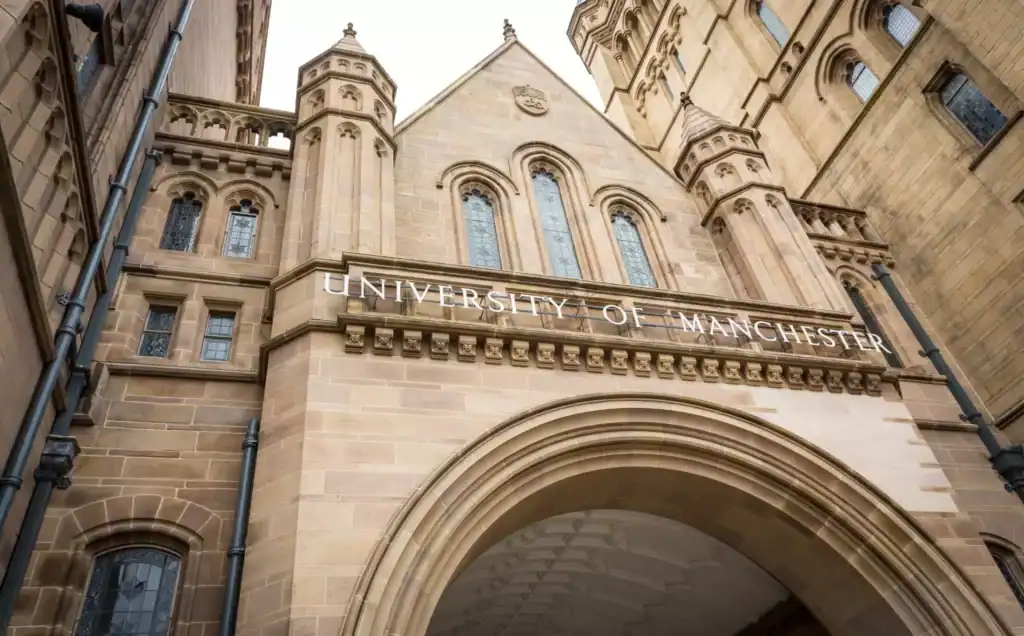
The MSc Digital Marketing is a 12-month, full-time master’s with a September intake each year. Students need 180 credits: 8 courses of 15 credits each (120 credits in total) plus a large Digital Marketing Venture Project (60 credits). The program balances theory and practice, and the core modules include:
- Marketing Analytics and Market Research in a Digital Context: data-driven market research and marketing analysis.
- Customer Behaviour in a Digital Environment and Services Marketing: Sustainable Customer Experience Management: how consumers make decisions in a digital environment.
- Digital Content and Omnichannel Marketing and Social Media and Search Engine Marketing: planning and running cross-platform content and social media marketing campaigns.
Beyond the classroom, students take part in the Venture Project, which simulates real business situations and applies data and marketing strategy to real cases, building industry ties and job skills.
Graduates of the MSc Digital Marketing go into a wide range of industries, including marketing, retail, PR, tech, advertising and consulting. Common job titles include Digital Marketing Specialist, Marketing Analyst, Brand Strategist, E-commerce Manager and Social Media Manager. With Manchester’s international reputation, its location in northwest England and a large alumni network, graduates can build industry contacts and work experience quickly. Overall, the program mixes theory with practice, and its graduates do well in the job market.
Why she applied and switched fields: from business administration to digital marketing
What first gave you the idea of doing a master’s abroad?
I first thought about studying in the UK because some of my relatives studied there. After hearing about their studies and life there, I wanted to experience that academic atmosphere and the mix of cultures myself. Also, my undergrad was in business administration, which, as the name suggests, means you learn a bit of everything but nothing in depth, and I wanted to build a clearer area of expertise. On top of that, UK master’s programs take one year, so I could get the degree quickly. That’s why I chose a one-year master’s in the UK.
Coming from business administration, what experiences or interests led you to focus on Digital Marketing and Business Analytics?
After finishing some required courses in my first year and the first half of my second year, I found I really liked marketing and data analysis. So from the second half of my second year and into my third year, I took more electives in data science, digital marketing, platform strategy, data processing and so on. The classes, and the discussions and presentations for midterm and final projects, made me more certain this was the direction I wanted to go.
I also used online resources to improve my data analysis and SQL skills, and saw for myself the insights data can bring to marketing decisions. That made me even more set on Digital Marketing and Business Analytics.
Writing the essays and SOP: turning experience into selling points
When writing your personal statement and SOP, how did you turn past experiences into professional skills and career goals, and get that across in the SOP?
First I list every experience from college. Then I break down each project or report into “what I did,” “what came of it” and “what I learned.” Finally I group all the experiences by the skills they show. That way I can pick the experiences that best fit the skills each school looks for in students, and link them clearly to my career goals.
Did you get stuck or go through many rewrites? How did you eventually find your core story and the logic of your essays?
At first I wanted to put in every experience I’d had, so my SOP looked very messy, had no clear thread, and didn’t really bring out my strengths. Later I realized how much the logic of the essay matters. I wrote a general version first as a base, then, depending on what each school and program expected, picked the experiences where I had an edge and adjusted it to make it more convincing.
What are the three most important messages your essays need to get across?
- A very clear motivation
- Concrete experiences, with results expressed in numbers
- Your plans for the future (which also have to be very clear)
Managing time: a school project, internships and exams at once
In your senior year you had a school project, an internship and IELTS prep all at once. How did you split your time?
I believe you can’t do something halfheartedly. You have to put everything into it.
In the first semester of my senior year I interned four days a week and had classes one day. At the internship I focused only on what my manager assigned, and didn’t think about my applications or my school project and homework. I only worked on the project and revised my application materials in the evenings after work and after class.
As for IELTS, I’d taken it once in my third year, but I only met Manchester’s minimum entry requirement (6.5 overall, 6 in each band), while the business school requires 7 (6.5 in each band). So after I got Manchester’s conditional offer in December, I started preparing for IELTS again, studying hard after work and on weekends!
I didn’t start IELTS prep in September when applications opened because I know my limits very well. If I do too many things at the same time, I won’t do any of them well ><
Which experience helped your application the most, and how did you present it in your essays or interviews?
Both internships helped my application a lot!
The first was at a Taiwanese biotech company, and the second at a French energy management and automation company, and the work was different in each. For me they were more like a process of exploration. I saw firsthand the differences between Taiwanese and foreign companies, and I came to understand Marketing and Employer Branding work much better. In my application essays, I adjusted how I framed them to fit the qualities Digital Marketing and Business Analytics programs look for.
A surprise during the process: the rejection letters
Can you tell us about getting a rejection letter because of a school’s administrative error?
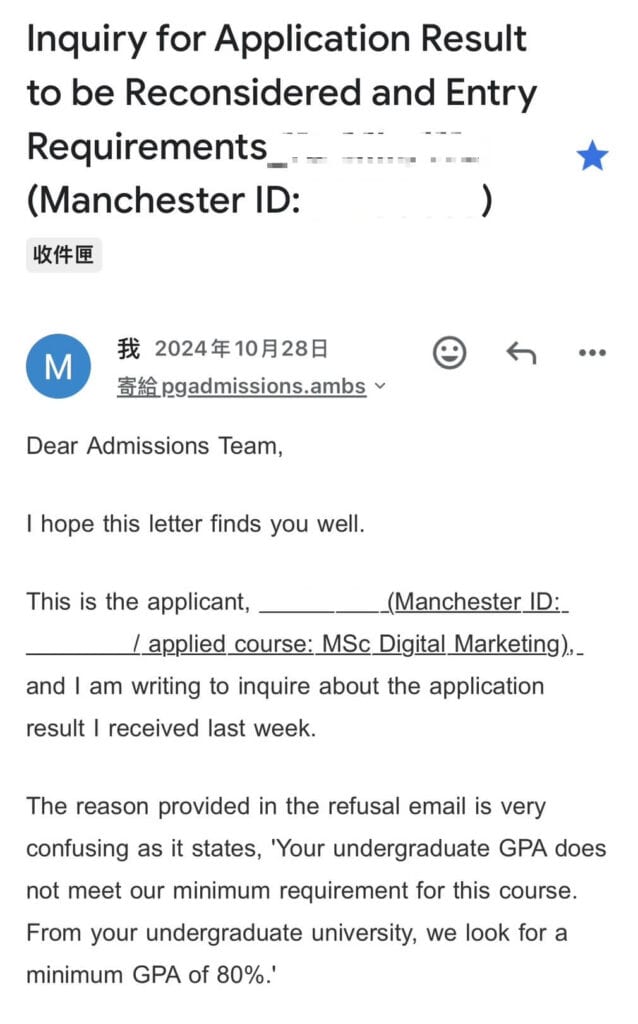
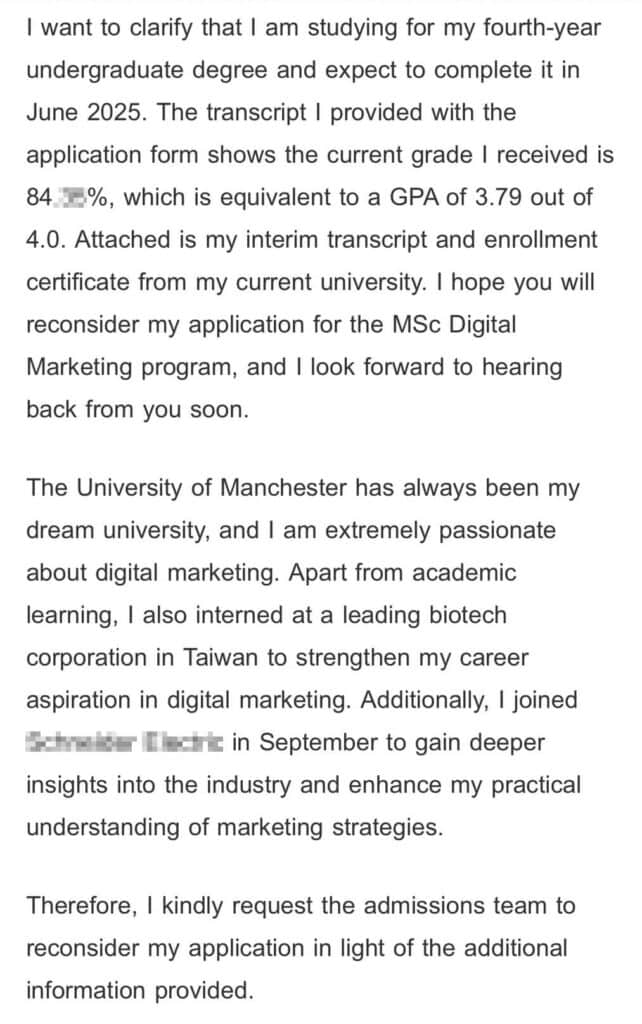
During the process, both Manchester and Durham sent me rejections because of administrative errors. The Manchester rejection came just three days after I submitted my application. When I saw it was a rejection I was devastated. I’d talked to a school representative before applying and he kept encouraging me to apply, so for a moment I thought he’d just been after my money ><.
The next day, when I told my family about the rejection, they reminded me to look at the reason. That’s when I saw the reason made no sense at all (it said my GPA was below 3.7)!! So I emailed the admissions office to explain, and they apologized and said there had been an administrative error ==. Durham had the same problem, so I won’t go into it again.
How did this affect your mood and your mindset about applying? How did you resolve it?
When you get a rejection, read the reason right away, and if it doesn’t make sense, appeal immediately!
I was too busy being upset to check the reason, so I was miserable for a whole day for nothing. It didn’t really affect my mindset about applying, though, because I’d already put my best effort into my application essays.
What two internships taught her
Why did you do an HR internship and a Marketing internship in college? When applying to marketing or business analytics programs, how did you pick out highlights and transferable skills?
- French energy management and automation company, Employer Branding & Talent Acquisition Intern
- Taiwanese biotech company, Marketing Intern
Both internships happened to give me exposure to marketing and data analysis.
In the employer branding internship, I mainly promoted the company’s culture and the openings it most needed to fill. That helped the TA team recruit the right people faster and attracted more potential candidates who identified with the company culture, and it strengthened my communication, collaboration and project management skills. The marketing internship at the biotech company built my data analysis and problem-solving skills and gave me a deeper understanding of channel marketing strategy and planning in the FMCG industry.
Because the two internships were quite different, I could pick whichever experience best showed the skills each program asked for, and turn transferable skills into highlights in my application!
What projects did you work on at the French company, and what did you gain that especially helped your Digital Marketing applications?
At that company I worked on several projects, including a cross-departmental employer branding project, promotion for a global business competition, and support for in-person recruiting events. I learned a lot from all of them.
- Working across countries and departments: besides my managers in Taiwan, I met regularly with the employer branding leader overseas to discuss what direction to take.
- Communication: besides internal collaboration, I also dealt with outside vendors to negotiate and move projects forward.
- Project management: I planned an employer branding campaign from scratch, from strategy and content planning to execution. That taught me how to turn marketing ideas into actual results.
How did the marketing research project at the biotech company help you show you can combine data analysis with marketing?
This internship was part of an industry-academia partnership with my school. I mainly learned what problems the company wanted to solve in its livestream marketing, then collected and organized the data, analyzed it in SPSS, found the main factors driving consumer purchase behavior, and gave the company solutions it could put into practice. Through that process I showed my data analysis skills, and I also turned the results into concrete marketing recommendations, which showed I could do marketing as well.
How would you suggest younger students “translate” internship experience into highlights in their applications?
- Break down your experience: know clearly what you did, what came of it and what you learned
- Match what the program expects: put your strongest experiences first
Choosing a school: from 4 offers to Manchester
Why did you apply to both Digital Marketing and Business Analytics programs?
I wanted a master’s that combined marketing decisions with data analysis, so most of the programs I applied to sat where those two fields overlap, just with different weightings. Some leaned toward marketing strategy and consumer behavior, and others put more weight on data analysis and modeling.
What made you choose Manchester’s Digital Marketing in the end?
After getting offers from several schools, I was really torn about which program to choose. So I reached out on LinkedIn to students at those schools to learn about the courses, the school’s resources, career paths and so on.
My relatives also put me in touch with some people already working in digital marketing and business analytics. In the end, combining what those students and professionals told me with how I felt during my two internships, I chose digital marketing.
Advice for future applicants
If you could go back to your first or second year of college, what would you remind yourself to start early?
- Join more clubs and business competitions, or apply to be a campus ambassador, to build experience in different areas
- Study hard and keep your GPA high. I’d suggest 3.8/4.0 or above!
- Go to more workshops and campus talks to build connections with older students and people in the industry. It helps a lot later on.
What advice would you most like to give students without a marketing background who want to switch fields?
Marketing covers a lot of ground. Try internships in different marketing roles, or build experience through business competitions. Both are a big plus, and along the way you’ll find out what you like and what you’re good at!
How would you sum up your application journey in one sentence?
Set a clear goal, give it everything you have, and you will end up with a good result!
Jason’s Takeaway
At first Mindy tried to fit every experience into her SOP, and it came out messy with no clear thread. She then wrote a general version first and chose experiences to match what each school expected.
Jason, admitted to Columbia Business School’s MBA at 22 and founder of OfferLand.cc
Next step: list every experience from college, and for each one write down what you did, what came of it and what you learned.
