
📌 Featured, 💬 Career Reflections, 💬 Interview, 📢 Content Creation, 🔥 Personal Growth, 🚀 Career Growth, 🪞 Self-Reflection
From Deloitte to Google with Self-Reflection and Coffee Chats
Updated 2026/10/16
Jason’s Memo
When I moved from Deloitte to Google, I prepared for the job search in this order:
- Self-reflection: Figure out what you care about and where your strengths are. Once the goal is clear, your career choices start moving toward it.
- Connecting the dots: Use coffee chats to learn the details of the role, then map your past experience to the skills the role needs.
- Practice first: Apply to Tier 2 or Tier 3 roles for practice, adjust based on your conversion rate at each stage, and apply to your dream role last.
I was honored to be invited to Cake’s “People Q&A” interview series. I talked about moving from consulting at Deloitte to an account manager role at Google, the self-reflection I went through while applying for an MBA, and the job search strategies and interview lessons that helped me most. The journey had plenty of challenges, and I learned and grew a lot along the way. If you’re feeling lost in your career, preparing to study abroad, or thinking about switching jobs, I hope this interview gives you some direction and a bit of courage.
Tell us about your background and the key turning points in your career
Jason is an Account Manager in Google’s Large Customer Sales team and was admitted to Columbia Business School’s Deferred MBA. He runs the “Jason Career (@jason_career)” personal brand (Instagram, blog, YouTube), where he shares advice on early careers and studying abroad.
He studied business in college and spent 2 years as a consultant at Deloitte. Within one month, he moved from consulting into a global tech company and received 2 FAANG offers, one for Account Manager and one for Program Manager.
- 2020 – 2023: Founded a new media talent agency
- 2022: Admitted to Columbia Business School’s MBA
- 2022 – 2024: Consultant @Deloitte
- 2022 – 2024: Founded OfferLand.cc, an all-in-one platform for studying abroad and careers
- 2024: Program Manager @LinkedIn
- 2024 – Present: Account Manager (Large Customer Sales) @Google
You first came across self-reflection while applying for an MBA. How did it shape your life, career choices and actions afterward?
MBA applications ask a lot of deep questions: your short-, medium- and long-term career plans, what you hope to achieve with an MBA, the person you admire most, what kind of leader you are, and so on. Answering them took a lot of research and coffee chats with friends, family and even strangers to get first-hand insight.
Applying for the MBA pushed me to reflect on myself properly. I learned what I’m genuinely passionate about and where my strengths are, so I decided early on that I wanted to work in tech. Because my goal was clear, I tried to point both my career choices and the skills I built in my spare time toward it (a non-technical role in tech).
What was the biggest challenge in moving from consulting to Google, and how did you prepare and get through it?
For me, the biggest challenge was “connecting the dots” before sending my resume!
Before you apply, you need to understand the role itself (in my case, Account Manager in Google’s Large Customer Sales team). I set up coffee chats with strangers to learn the details: the day-to-day work, the challenges, the clients and the internal teams they deal with.
With that first-hand information, I could connect the dots: link my past projects to the skills the role would need, and show those links in my resume and interviews. For example, here is how I matched the 3 main skills the role needed to my own experience:
- Client relationships, sales and business development
➔ Pitching and selling as a founder, consulting experience at Deloitte
- Project management (hard and soft skills)
➔ Leading a team at my startup, serving as project lead in my full-time job
- Domain Knowledge, Ads, and Marketing Career Insights
➔ Founding a new media talent agency, running the Jason Career brand, founding OfferLand.cc
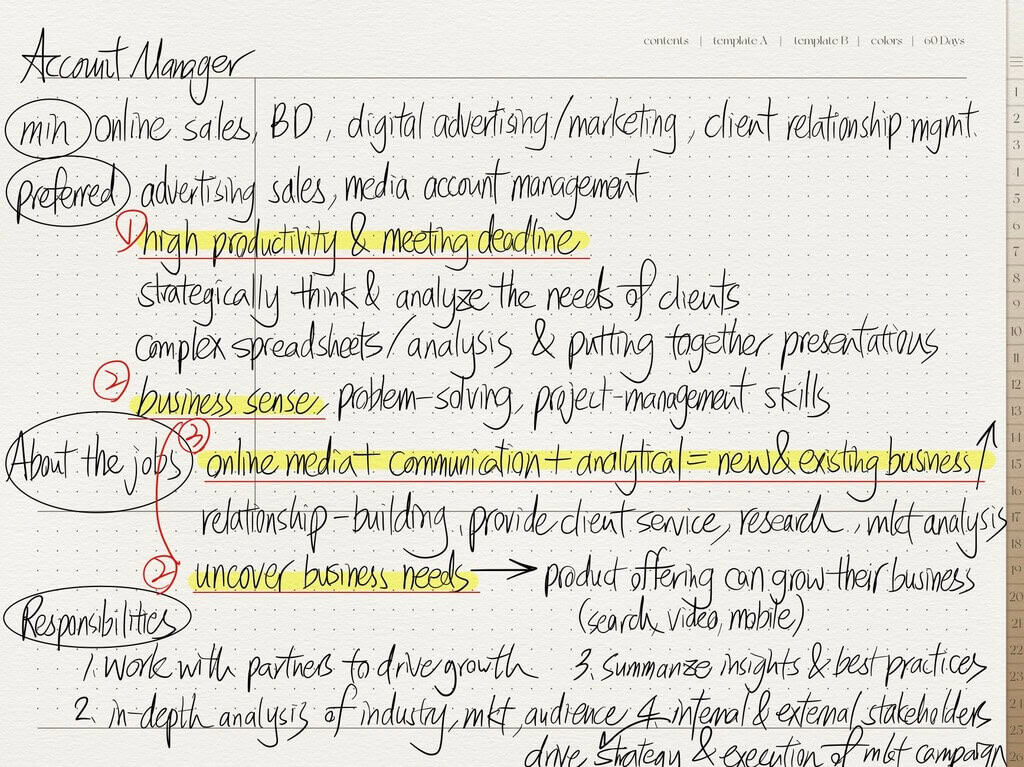
As you can see above, I wrote Google’s job requirements down in my notes and picked out the experiences where I thought I had an edge and that deserved extra emphasis in my resume and interviews.
Which resume and interview strategies helped you most but tend to get overlooked? Think highlighting achievements, building your personal story and positioning your strengths
I think the ideal job search goes like this:
Self-reflection ➔ Connecting the dots ➔ Apply to your Tier 2 or Tier 3 roles first for trial and error ➔ Apply to your dream role last
You can also look at two “conversion rates”, from application to interview and from interview to offer, to see where you need to improve. Say you’ve sent out a lot of resumes but received few interview invitations. That’s the moment to stop and check whether your resume needs work. If you have the time, I strongly recommend starting with Tier 2 or Tier 3 roles for trial and error. You can keep adjusting your application documents as you go, stay in top job-hunting shape, and improve your chances of landing the dream offer when it counts.
For the first two steps, self-reflection and connecting the dots, coffee chats are essential. Without them, everything you know comes second-hand from the internet. Coffee chats give you first-hand information, and those first-hand insights and tips are often what make you stand out.
What common mistakes do candidates make when interviewing with global companies?
I’ve reviewed a lot of resumes from students and younger professionals, and more than 70% have basic mistakes in format and approach: how the bullet points are written, the layout, and how well they show the link between the candidate and the role. However strong your skills or past performance, if your resume can’t communicate them, you’ll never get to the next round to tell an interviewer about them. I often find that a real shame.
I think the main cause is not staying open-minded. A lot of people (me included) finish a resume or portfolio, feel pleased with it, and can’t see their own blind spots. They stop looking for more information or asking for other people’s opinions.
If you stay open-minded, ask friends, family or even strangers for feedback on your resume, or read guides online, I believe you can avoid more than 80% of the basic problems. There isn’t space to go through resume principles here, but I’ve shared many of them on Instagram (@jason_career) along with resume templates, and I really recommend checking them out!
Beyond staying open-minded and improving, I’ve coached many people who had rich experience but didn’t see it that way, or hadn’t found what was distinctive about it. That’s when you need to dig up your “hidden experience” and turn low-value-looking dirty work into high-value experience. I really recommend talking to friends or colleagues. Ask them directly what they think of you, including your strengths and even your weaknesses. You’ll often find strengths you never noticed.
Self-reflection doesn’t always have to start with you. Sometimes the feedback other people give you is what helps you reflect and find your strengths.
You’ve said coffee chats helped your job search a lot. How do you build real connections and make people remember you?
Start by finding the “right strangers.” Reach out first to people who have something in common with you, highlight that connection, and explain why you want to talk to them in particular. They’ll relate more to your job search or study plans and be more willing to help. And people with a background like yours can share experience that’s more useful to you. I start with alumni (from university or even high school) and friends of friends, then seniors or colleagues with a similar work background. What you have in common is a natural connection that makes the other person feel closer to you.
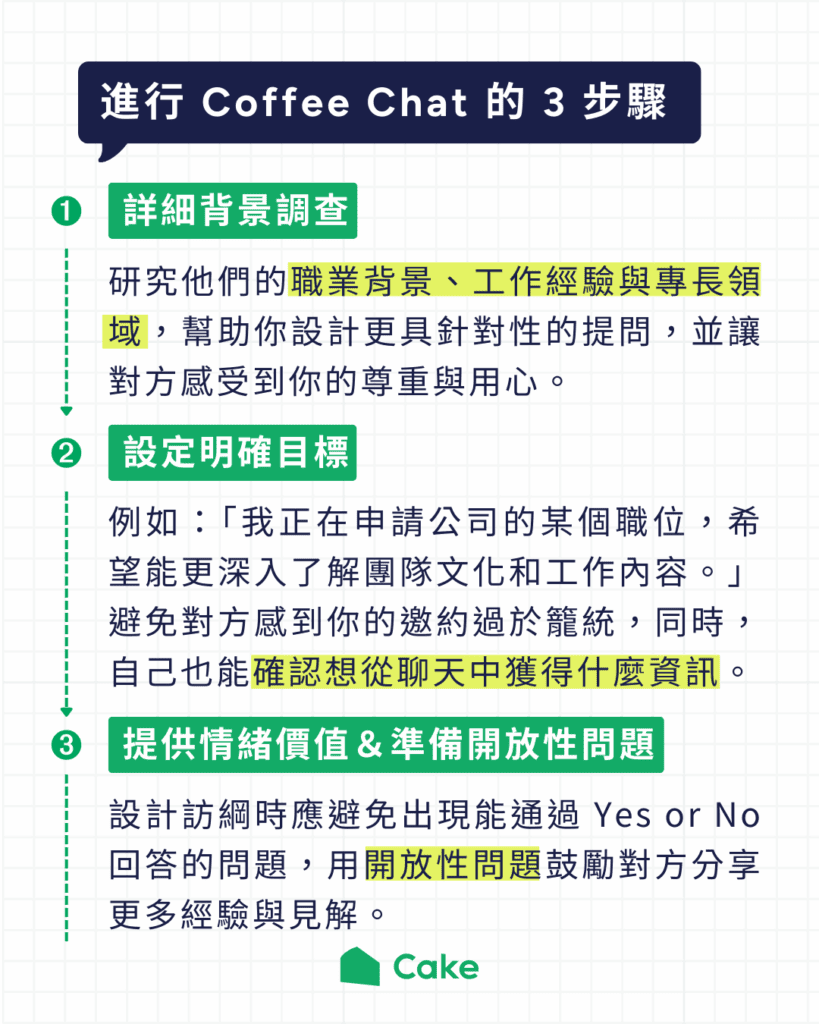
Here are 3 steps to prepare well for a coffee chat:
Research their background
Before you meet, study their career background, work experience, areas of expertise and even some personal interests. This helps you ask more targeted questions and shows that you respect them and put in the effort. For example, look at their career path on LinkedIn and find experience related to your goal. Knowing the person well, including their background, experience and hobbies, helps you find common ground during the chat and better understand their role, team and even their standing in the industry.
Set a clear goal
When you send the coffee chat invitation, state briefly and clearly what you hope to get out of it. For example: “I’m applying for the [position] at your company and would love to learn more about the team culture and the work.” That way your invitation doesn’t feel vague or aimless. It also makes you decide in advance what you want from the conversation, such as understanding the company culture, getting career advice or growing your network. With a clear goal, you can ask focused questions and come away with useful information.
Offer emotional value and prepare open-ended questions
Avoid questions that can be answered with a simple yes or no. Open-ended questions encourage the other person to share more of their experience and views. Questions that are too general are hard to answer and suggest you don’t respect their time, which backfires. Start with questions about what you have in common and adapt to their answers. For example, I like to ask how a previous job of theirs that I know something about differs from their current one, then respond from my own experience and offer some emotional value, which makes them more willing to share.
Sincerity beats every trick. Connecting with people comes down to sincerity and mutual benefit, and only sincere interactions earn someone’s support and trust.
- Further reading: The LinkedIn message that got me a global company offer: how to contact strangers and my LinkedIn coffee chat tips
Why did you start “Jason Career”, and how did that identity take shape?
I started Jason Career because I noticed there was very little information in Chinese about Deferred MBA programs, so while applying I decided I’d write about it if I got in. Later, knowing how hard applying abroad and job hunting can be, I started writing more articles to help more people reach their potential.
I was lucky to be admitted to Columbia’s MBA as a college senior. The application introduced me to self-reflection, which helped me understand my strengths, goals and passions much better. Within two years of graduating, I moved from consulting to an account manager role at Google.
Looking back, what changed me most about the MBA was being forced to reflect while writing the application essays. It made me stop what I was doing, slow down, and really look back and think.
After coaching 350+ people, I’m even more convinced of how much self-reflection matters for study abroad and job applications. Having been through it myself, I hope the articles and resources I share can take some pressure off readers, save them time, help them avoid detours and land their dream offers.
You’ve said study abroad consultants charge unfairly high fees, so you wanted to create affordable content that can reach more people. What values drive that?
Back then I saw the industry charging crazy, unbelievable fees. Spending 100,000 just to apply to 4 to 6 schools? And for an MBA, consulting fees could reach 300,000?! That didn’t feel right to me at all. It seemed that only people willing to pay that much could get professional knowledge and services. It’s realistic and reasonable from a business point of view, but to me it didn’t seem fair…
Then it hit me: I could combine my study abroad and career expertise with my earlier experience in startups and product management, and offer solutions to the problems I had faced while applying for my MBA:
How do I figure out which schools are within reach?
→ So I built OfferLand.cc, an all-in-one platform for studying abroad and careers (admission results, an interview question bank, a peer network, mentor matching and a forum). When choosing schools and judging their chances, people can look at past applicants’ data, connect with them and learn from their experience.
Which schools and programs should I apply to?
→ So I hosted 30+ free online talks and uploaded them to YouTube, giving people a range of first-hand information and experience.
Since then, my mission has become clearer: use Instagram, the blog, talks and other channels to share my insights on studying abroad and careers with more people for free.
I also believe everyone is unique, and telling a true story is the best way to crack a study abroad application. So as a mentor, I focus on self-reflection and on uncovering people’s strengths and personal stories.
You wear many hats: Google sales, founder and content creator. How do these roles influence each other, and how do you balance them?
Each role affects me differently and has broadened my view of life in a different way. As “Jason Career”, the content creator and study abroad and career consultant, I’ve helped 350+ people over the past three years apply to master’s and MBA programs across different schools and countries. While reviewing their resumes, advising on essays and preparing them for interviews, I’ve heard so many stories. Through their eyes, I’ve seen the challenges people face at different stages of life and from different backgrounds.
I especially remember one student applying for US MBA programs. I worked with her from exploring her career story and rebuilding the logic of her application to editing her essays word by word and running mock interviews again and again. Like many people who come to me, she had very little confidence at first and said things like “It’s fine, as long as I get into a safety school…” I clearly remember how excited and moved she was when she finally got her dream MBA offer, and how she could hardly believe what she had achieved. I’ve met many students like her over these three years: people I consider excellent who don’t believe in their own abilities and aim only for a safe choice. I see my role as Jason Career as helping people make the most of their potential, so fewer of them miss their dreams by underestimating themselves.
As the founder of OfferLand.cc, I’ve been lucky to build a platform used by thousands of people from scratch, together with partners from different backgrounds. It also showed me the value of education and career guidance. I never imagined a side project would become such an important piece of my life. It grew into OfferLand’s free study abroad mentoring program, the “Mantou Project”, which has now run for three cohorts, so helping younger students is no longer a one-person effort but a structured way of passing experience on. I’m always moved when users send positive feedback or actually build connections through OfferLand. I hope to keep expanding this, beyond content creation, by connecting more learning resources, life turning points and career opportunities. I believe that as long as some people are willing to share and some are willing to walk alongside others, every uncertain future can open up endless possibilities.
My job as an account manager at Google puts me on the front line of digital advertising and global marketing. I help clients expand into overseas markets, which means understanding business logic, industry trends and how users differ around the world, on top of ad strategy itself. Working closely with internal product, data and creative teams, I’ve learned to break problems down systematically, let data do the talking, and create value for clients with simple, strong messages. The job has widened my international perspective and shown me how technology, marketing and talent build on each other to create lasting impact.
All of this has made me even more convinced that career development goes beyond resume and interview prep. It’s about helping someone find their direction and their own value, and get onto the stage that suits them. That belief runs through my work at Google and shapes everything I do at Jason Career and at OfferLand. Rather than saying I’m helping others, I’d say we lift each other up and each write our own career stories.
What’s your motto? And what advice would you give to new graduates?
Maximum Effort = Zero Regrets
I’ve held onto this motto through school applications and job hunting, and it has eased a lot of my anxiety.
I used to want every step planned out. Right after graduating, I reached out to many alumni on LinkedIn for coffee chats, trying to find “the one right path.” One conversation still stays with me. The person said life can never be fully planned, but if we have a clear general direction and are willing to put in the effort, many things will fall into place over time.
My advice for new graduates: Don’t be afraid of uncertainty, and don’t rush to lock in your future. Rather than searching for the one answer, keep moving, keep building and keep acting. When you give it everything, you won’t regret it even if things don’t turn out as you hoped.
Jason’s Takeaway
My motto is Maximum Effort = Zero Regrets. Give it everything, and you won’t regret it even if things don’t go as hoped.
Jason, who planned his career backward from the goal and landed a Google offer at 24
Next step: Write your target role’s requirements in your notes and list the experiences you can match to each one.
